Last week in our online lecture series in Cardiff, Pete Clifton - Head of BBC News Interactive, aired some of his thought about how his online journalists might in future get closer to the rest of the BBC's journos. He's apparently developing a strategy for future integration which might, quite conceivably, be a strategy for deleting his empire; subsuming it into the general run of what BBC journalists do.
How interesting that today's speaker, Sarah Radford from NewburyToday - the award winning web presence of a weekly Berkshire newspaper, brought along a video of her boss, Martin Robertshaw, describing almost exactly the same organisational, managerial issue.
From one end of the online spectrum to the other - the issue is the same. And I'm sure neither Sarah nor Martin, with their twenty or so journalists, would mind being described as being from the other end of the spectrum to the BBC with its thousands of hacks.
How do you integrate the online operation into the traditional "day-job"? Those who get it right will have a profound impact on the working lives of all today's journalism students.
Showing posts with label journalism. Show all posts
Showing posts with label journalism. Show all posts
Thursday, November 23, 2006

Friday, November 10, 2006
Jon Snow and those poppies
Is sporting a red poppy in the run-up to remembrance day really something that compromises the impartiality/objectivity of a journalist?
That seems to be what Jon Snow is saying.
Interestingly the BBC's Controller Editorial Policy got himself into a right tangle on Radio 4's PM this evening when asked to defend what appears to be a long-standing and, importantly, unquestioned policy of allowing (encouraging even?) newsreaders and reporters to wear poppies - a more or less unique privilege allowed to this charity.
World War One has now passed out of living memory, it won't be long before the 2nd World War follows it into the history books. How long can it be before the whole paraphanalia of official remembrance on November 11th each year follows?
It will be a while yet I suspect. But as the parades of veterans diminish, the question has to be asked.
The trick is going to be to find a new way to honour the sacrifices made by members of the armed forces in smaller and less universally popular causes.
That seems to be what Jon Snow is saying.
Interestingly the BBC's Controller Editorial Policy got himself into a right tangle on Radio 4's PM this evening when asked to defend what appears to be a long-standing and, importantly, unquestioned policy of allowing (encouraging even?) newsreaders and reporters to wear poppies - a more or less unique privilege allowed to this charity.
World War One has now passed out of living memory, it won't be long before the 2nd World War follows it into the history books. How long can it be before the whole paraphanalia of official remembrance on November 11th each year follows?
It will be a while yet I suspect. But as the parades of veterans diminish, the question has to be asked.
The trick is going to be to find a new way to honour the sacrifices made by members of the armed forces in smaller and less universally popular causes.
Friday, October 20, 2006
What Iain Dale actually said...
We (the staff) often characterise our postgrad journalism students as ruthlessly careerist, tending to reject any aspect of the course that doesn't obviously relate to their immediate career goals.
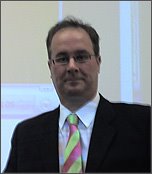 Iain Dale might have fallen foul of that. He didn't, and I think the reason he didn't is because he was so obviously 'one of us' - Iain comes over as a journalist first and a politician second. He is, of course, one of the new breed of 'citizen journalists' that so troubles students like ours.
And well it might - they are adding mightily to their debts to pay to become professional journalists - and here we are saying 'anyone can do it'.
Of course we're not. For one thing, Iain Dale isn't anyone. More importantly, this is the world they're going to have to cope with - a world I believe will have an even greater need for professionals with the skill to pull it together, context it and reflect it back.
I've looked throught many, but by no means all, of the student blogs about Iain's talk. This is the one that's struck me as the most pertinent I've seen so far (it comes from the modest Ollie Hawkins).
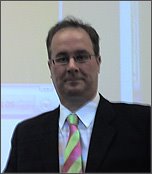 Iain Dale might have fallen foul of that. He didn't, and I think the reason he didn't is because he was so obviously 'one of us' - Iain comes over as a journalist first and a politician second. He is, of course, one of the new breed of 'citizen journalists' that so troubles students like ours.
And well it might - they are adding mightily to their debts to pay to become professional journalists - and here we are saying 'anyone can do it'.
Of course we're not. For one thing, Iain Dale isn't anyone. More importantly, this is the world they're going to have to cope with - a world I believe will have an even greater need for professionals with the skill to pull it together, context it and reflect it back.
I've looked throught many, but by no means all, of the student blogs about Iain's talk. This is the one that's struck me as the most pertinent I've seen so far (it comes from the modest Ollie Hawkins).
Wednesday, October 11, 2006
Soldiers, policemen and firemen
Forgive the sexist title.
This is prompted by an item on the BBC 10 o'clock last night on the pay of soldiers serving in Afghanistan.
I, like so many of us do, saw this with half my mind. I do remember thinking "soldier £14k a year, policeman £30k. Can this be right?". Then it was time for bed.
But that's what the BBC said.
All credit to my colleague teaching on the Cardiff course, Ros Bew, who picked that item up for her session today with our postgraduates.
It took no more than 30 seconds before 30 aspiring broadcast journalists had googled their way to a number of sources that showed the BBC story to be, at best, a half truth. The BBC was comparing the best of one with the worst of the other.
Huw, Craig I hope you read this.
This is prompted by an item on the BBC 10 o'clock last night on the pay of soldiers serving in Afghanistan.
I, like so many of us do, saw this with half my mind. I do remember thinking "soldier £14k a year, policeman £30k. Can this be right?". Then it was time for bed.
But that's what the BBC said.
All credit to my colleague teaching on the Cardiff course, Ros Bew, who picked that item up for her session today with our postgraduates.
It took no more than 30 seconds before 30 aspiring broadcast journalists had googled their way to a number of sources that showed the BBC story to be, at best, a half truth. The BBC was comparing the best of one with the worst of the other.
Huw, Craig I hope you read this.
Subscribe to:
Posts (Atom)